
Download
Growth Rate ( % ) = ( Final weight (kg) − Initial weight/Rearing period (days) × 100 
Antioxidant capacity (% inhibition ) = Ao(DPPH without extract) − A1( DPPH with extract) Ao × 100 Inhibition % = 1 − [ Absorbance of smaple Absorbance of control ] × 100 


RESEARCH
Enhancing nutritional quality and antioxidant capacity of organic goat meat through sustainable sea-buckthorn and Russian olive leaf–based feeding systems
Furukh Faiz 1, Asif Wali 2, Amjad Ali 1, Abdul Razaq 3, Muhammad Arshad 1, Nashi K. Alqahtani 4, Mahmoud Helal 5, Rokayya Sami 6*, Guohua Qiao 7, Buthaina M. Aljehany 8, Eman A. Abduljawad 8, Abeer A. Aljehani 8, Sarah S. Aggad 8
1Department of Agriculture and Food Technology, Karakoram International University, Gilgit, Pakistan;
2Faculty of Life Sciences, Karakorum International University, Diamer Campus, Chilas, Pakistan;
3Faculty of Life Sciences, Department of Biological Sciences, Karakoram International University, Gilgit, Pakistan;
4Department of Food and Nutrition Sciences, College of Agricultural and Food Sciences, King Faisal University, Al-Ahsa, Saudi Arabia;
5Department of Mechanical Engineering, Faculty of Engineering, Taif University, Taif, Saudi Arabia;
6Department of Food Science and Nutrition, College of Sciences, Taif University, Taif, Saudi Arabia;
7College of Grain Science & Technology, Shenyang Normal University, China;
8Department of Food and Nutrition, Faculty of Human Sciences and Design, King Abdulaziz University, Jeddah, Saudi Arabia
Abstract
As consumer demand for organic products increases, understanding how organic diet influences meat characteristics can provide an insight into enhancing the health benefits and sustainability of goat farming. This study explored an approach to produce premium organic goat meat enriched with superior nutritional qualities by incorporating sea-buckthorn (SBT) and Russian olive leaves (ROL) into the feeding regimen over a 6-month period. During the evening feeding period, four feeding regimes were administrated to the subjects MS (i) consisting of alfalfa hay and grass; MS (ii) consisting of SBT leaves; MS (iii) comprising of ROL; and MS (iv) involving a mixed ration of Russian olive and SBT leaves. These interventions were implemented to evaluate comparative nutritional efficacy under controlled circumstances. In the feed analysis, SBT leaves showed high crude protein content (19.02%) and dry matter (92.79%), while grass hay and alfalfa hay had higher ash content (10.01 and 9.19%) and fiber content (24.82%) in alfalfa hay. Fiber was lowest in SBT leaves (2.65%), highlighting their potential as a rich-feed protein source. Furthermore, the meat from different treatments were analyzed for physiochemical, antioxidant, and mineral content. Highly significant effects were observed for mass of carcass, and MS (i) scored maximum weight gain (3.73 kg), protein contents, fats, and ash. MS (iv) scored the maximum thiobarbituric acid reactive substance, DPPH, and phenolic of 67.52 μmol TE/g, 38.89 μmol MDA/g, and 50.60 mg GAE/g for different treatments while non-significant effects for moisture, fat, and ABTS were observed for different feeding systems. Based on the findings of the current study, it can be suggested that MS (iv) scored the highest rank among the management systems tested, while the meat obtained from the MS (iv) approach had good nutritional value, which could improve and fulfill nutritional requirements of the consumers.
Key words: Goat meat, Feed management systems, Antioxidants, TBARS, Organic meat
*Corresponding Author: Rokayya Sami, Department of Food Science and Nutrition, College of Sciences, Taif University, P.O. Box 11099, Taif 21944, Saudi Arabia. Email: [email protected]
Academic Editor: Prof. Massimiliano Rinaldi, University of Parma, Italy
Received: 13 May 2025; Accepted: 30 November 2025; Published: 1 January 2026
© 2026 Codon Publications
This is an Open Access article distributed under the terms of the Creative Commons Attribution-NonCommercial-ShareAlike 4.0 International (CC BY-NC-SA 4.0). License (http://creativecommons.org/licenses/by-nc-sa/4.0/)
Introduction
The increasing demand for organic goat meat is driven by its promising nutritional profile, ethical production, and association with consumer acceptance for sustainable healthy diets. Furthermore, goat meat is a rich source of high-quality macro- and micronutrients, while being low in fat and cholesterol, making it a lean and nutritious dietary option (Ahmad et al., 2021; Hambaryan et al., 2024). In addition, organic production systems further enhance their appeal by ensuring food safety, animal welfare, and environmental sustainability through the exclusion of synthetic chemicals, growth-promoting hormones, and GMOs (lu et al., 2010). In spite of its valuable nutritional composition and emerging dietary trends, Western societies are trying to reduce and/or replace meat from human diets (Bohrer 2017, Muzaffar et al., 2021). Therefore, researchers are finding innovative ways to maintain the interest on meat. One such approach involves incorporating naturally antioxidant-rich plants either into animal feed or directly onto the meat to enhance preservation and quality (Vlaicu and Untea, 2024).
Antioxidants are incorporated either through animal feed or directly as additives in meat to improve its quality. This is often achieved through the application of synthetic antioxidants as dietary supplements (Nemati et al., 2024). Notwithstanding their widespread use and efficacy, substantial concerns exist regarding the possible carcinogenic and toxicological effect of synthetic antioxidants. Previous studies have shown that synthetic antioxidants like BHA, PG, and TBHQ can exhibit genotoxic and cytotoxic effects (Carocho et al., 2018; Esazadeh et al., 2024; Kumar et al., 2015). Different studies (Cuchillo-Hilario et al., 2024; Fernandez-Lopez et al., 2005; Ponnampalam et al., 2024; Vlaicu et al., 2024) suggest that natural compounds demonstrate significant potential in protecting human health and toning down foodborne illnesses. In addition, the incorporation of their natural antioxidant compound into animal feed signifies an effective and practical approach for improving animal health and meat quality as demonstrated by Alqahtani et al., (2021) and Nieto et al. (2010). Natural compounds such as antioxidants particularly from plant sources have been considered to be highly effective in mitigating oxidative damage within the meat industry. Moreover, their efficiency stems from their capability to neutralize free radicals and donate hydrogen or electron atoms and chelate metal ions, which is accredited to their unique chemical structure (Das et al., 2024). Sea-buckthorn (SBT) leaves have shown significant promise as a dietary supplement in animal feed predominantly for their potential to enhance meat quality and nutritional values in livestock. This herbaceous plant documented for its rich composition of antioxidant polyphenols and various other bioactive compounds has been studied (Wang et al., 2024; Munoz et al., 2023; Qin et al., 2020) for various applications in animal nutrition leading to enhanced health growth performance and meat quality (Wani et al., 2026). The mechanism by which SBT leaves improve meat quality is often linked to their bioactive compounds, for instance similar to alfalfa leaves, SBT leaves could potentially improve meat quality by enhancing the antioxidant capacity of animal tissue and modulating lipid metabolism (Jin et al., 2013). This leads to an increase in intermuscular fat, which contributes to flavor such as juiciness, and in the end improved fatty acid profile (Guo et al., 2023). Russian olive oil (Elaeagnus angustifolia) seems to be a promising addition in animal feed ingredients, particularly for goats, because of its nutritional profile and potential to enhance meat quality. This plant is known for its resilience to various environmental stresses and contain macronutrients such as phosphorus, nitrogen, magnesium, potassium, and calcium in its dry foliage, making it a potentially beneficial ingredient for animal feed supplementation (Hamidpour et al., 2017). The plant-based feedstuffs including olive cake and cactus has been incorporated in the feed of the goats which exhibited the better profile of the fatty acid contents, as the omega 3 fatty acids have been enhanced (El Otmani et al., 2021; Paiva-Martins et al., 2009; Innosa et al., 2020; Obeidat et al., 2023). Specifically concerning to goat meat quality dietary olive leaves addition as a meal in animal feed has shown better affects. A study by Jabalbarezi et al. (2020) showed that increasing meal (ROL) levels from 7.5 to 15% of diet did not significantly affect the total dry matter intake or growth rate, but specific impact on meat quality parameters warrant further comprehensive investigation. The synergistic accumulation of nutrition-dense, bioactively rich plant leaves in animal feed offer substantial potential to enhance the nutritional quality and antioxidant capacity of meat. This study aims to produce high-quality organic meat by including these enriched bioactive plant leaves in animal diets with subsequent evaluation of the meats’ nutritional composition and antioxidant activities to further validate the efficacy of this emergent feeding approach.
Material and Methods
Procurement of meat
The Ishkomen Valley in the Ghizer district of Gilgit-Baltistan, Pakistan, provided the meat for the study. Each of the 24 goats we chose was about 6 months old. We thoroughly examined the goats before purchasing to make sure they had not been administered antibiotics or commercial feed items, hormones, or toxins. In addition, we divided the goats into four groups at random to investigate the effects of various management strategies on meat production. The configuration of these groups was comparable to that of our previous study (Faiz et al., 2020). For 6 months, the goats were maintained on their own feeding schedules. The goats were carefully slaughtered at the end of this period, and their carcasses were separated into various anatomical parts, such as the ribs, back, neck, forelimb, and hindlimb. In order to preserve their quality and integrity for upcoming biochemical and nutritional tests, the acquired meat samples were also thereafter kept in a frozen environment. Figure 1 shows a summary of the experimental workflow.
Growth rate measurements
From the beginning until their humane slaughter 6 months later, the experimental goats were weighed monthly by the researchers. In addition, prior to the trial, we administered albendazole to the goats at the dosage recommended based on body weight. Throughout the trial, the goats were housed in groups rather than separate enclosures, given a regulated food, and had unrestricted access to water. In order to maintain consistency, measurements were taken early in the morning following an overnight fast, and their average weight was reported each month. The body weight of a goat was determined:
Figure 1. Summary of the experimental work.
Physicochemical Tests
Proximate composition
The AOAC (2006) established standardized procedures for the proximate analysis of goat meat, which included measurements of moisture content, ash, fat, crude protein, and crude fiber. Similarly, we dried 5 g of beef samples in an oven at 105±2°C until the samples attained a constant weight in order to measure the moisture content. The Kjeldahl methodology, established by AOAC (2006), was used for evaluating crude protein. It entailed digesting samples (goat flesh) and then distilling and titrating the results to guarantee accuracy. In order to effectively extract and measure the lipids in goat meat samples, besides using the Soxhlet extraction technique with petroleum ether as the solvent within the boiling range (40–60°C), researchers burned 2 g of goat flesh samples in a muffle furnace set at 550 ± 20°C for 6–8 hours, or until a stable ash residue was obtained, in order to measure the amount of ash present. In addition, crude fiber was measured by sequentially digesting it with 1.25 % of NaOH and 1.25% H2SO4 followed by ignition at 550 ± 25°C to measure the indigestible residue, ensuring precise outcomes.
Determination of antioxidant activity
The DPPH (2,2,-diphenyly-1-picrylhydrzyl) free radical scavenging assay was used to evaluate the antioxidant activity of the beef sample (Merculieff et al., 2014). Methanolic solution (DPPH) (1.9 mL) and 100 µL of meat extract were combined in a volumetric flask. For consistent homogenization, the mixture was agitated well before being incubated for 35 minutes at a regulated temperature of 37°C in a dark condition. Using a Cary 60 UV-Vis spectrophotometer, the absorbance of the solution was measured at 517 nm following incubation. The antioxidant activity of goat meat extracts was measured as the percentage of the DPPH radical.
Determination of ABTS
Following the procedure described by Qwele et al. (2013), researchers used the ABTS (2,2′-azino-bis(3-ethylbenzothiazoline-6-sulfonic acid)) radical scavenging assay to evaluate the antioxidant activity of meat samples. To produce ABTS•+ radicals, scientists prepared two stock solutions (2.4 mM and 7 mM potassium persulfate) in equal volumes and kept them at room temperature in darkness for 1 day. Before analysis, we diluted the resulting solutions with ethanol to achieve an absorbance of 0.7 ± 0.2 at 734 nm, using ethanol as the blank reference. We then measured the absorbance of the goat meat samples and calculated the percentage (%) inhibition of ABTS radicals using the provided formula.
Determination of thiobarbituric acid reactive substance (TBARS)
To evaluate the lipid oxidation of the goat meat sample, we conducted the TBARS assays following the method by Hussain et al., (2021). Briefly, we blended 10 g of minced meat with 30 mL of 7.5% trichloroacetic acid (TCA) at 15,000 rpm for 30 seconds at 20°C. After filtering the mixture, we further added 5 mL of 0.02 M thiobarbituric acid (TBA) to the filtrate, sealed the mixture in tubes, and heated it to 100°C for 35 minutes. The samples were then cooled to 20°C. We measured absorbance at 532 nm using an Ultraspec 3000 spectrophotometer (Pharmica, Bio-Tech, UK) with a blank prepared using distilled water and TBA reagent as reference. TBARS (mg MDA/kg meat) values, expressed as milligram monoaldehyde (MDA-kg) of goat meat, were quantified using a tetraethoxypropane (TEP) standard curve. For consistency, the same samples were subjected to both fluorescence and TBARS tests.
Data Analysis
Randomized complete design (RCD) was used to examine the data and assess sample parameter variances. SPSS (version 16, IBM Corporation NY, USA) means and standard deviations were calculated and a one-way ANOVA was carried out. The Tukey post-hoc test with a significance level of P<0.05 was used to evaluate meaningful differences between means.
Results
Feed composition
Statistical analysis revealed that crude protein, ash, and crude fiber exhibited statistically significant (p<0.05) variations across grass hay, alfalfa, ROL, and SBT leaves. In contrast, dry matter exhibited no significant variations at the p>0.05 level among all tested feed samples (Figure 2). Alfalfa hay and grass hay had higher ash content (9.19 and 10.01%, respectively) as compared to ROL (5.34%) and SBT leaves (4.11%). In addition, crude protein was maximum in SBT leaves (19.02 %) and minimum in ROL (12.67%). Fiber content was observed to be higher in alfalfa hay (24.82 %) and lower in SBT (2.65%). Maximum value for dry matter (92.79%) was observed in SBT leaves, and minimum values were found in alfalfa hay (88.56%).
Effect of formulated feed on growth rate of animals
Table 1 presents mean values of weight gain from initial body weight to slaughter weight of animals fed on different feeds. The statistical values for growth rate of goats were highly significant (p<0.05) among all management systems, namely, MS (i), MS (ii), MS (iii), and MS (iv). The highest weight gain was observed in lambs fed under the MS (i) regimen, while the lowest weight gain was recorded in those receiving the MS (iii) feeding protocols.
Carcass weight
The carcass mass of goats exhibited statistically significant differences (p<0.05) for all the management systems. Table 2 shows the weight of the carcass at the time of slaughter (slaughter weight) with hot carcass weight (meat after dressing) and weight of body parts. Moreover, the differences in slaughter weight were attributed to the variations in goats’ preslaughter weight. However, maximum carcass weight was observed in the group which was fed under MS (i).
Figure 2. Proximate composition of alfalfa, hay grass, Russian Olives leaves, and sea buckthorn leaves. Mean values are shown with markers, bars represents Std± (n=3), and different letters a–b indicate significant differences between management systems, p<0.05.
Table 1. Growth rate during 6 months of organic feeding.
| Management system | MS (i) | MS (ii) | MS (iii) | MS (iv) |
|---|---|---|---|---|
| Initial weight (Kg) | 12.04±0.01h | 12.57±0.02h | 12.43±0.01h | 12.50±0.01h |
| First month | 12.85±0.01g | 12.94±0.01g | 12.7267±0.01g | 12.83±0.02g |
| Second month | 13.63±0.01f | 13.32±0.02f | 13.08±0.01f | 13.20±0.02f |
| Third month | 14.12±0.02e | 13.76±0.02e | 13.47±0.01e | 13.62±0.01e |
| Fourth month | 14.74±0.01d | 14.14±0.02d | 13.83±0.02d | 14.04±0.01d |
| Fifth month | 15.21±0.01c | 14.68±0.01c | 14.18±0.01c | 14.43±0.02c |
| Sixth month | 15.78±0.01b | 15.21±0.01b | 14.82±0.02c | 15.02±0.01c |
| Total weight gain | 3.74±0.01a | 2.62±0.02a | 2.39±0.01a | 2.52±0.01a |
All values are expressed as the mean ± standard deviation. Statistically significant differences are denoted by means of distinct letters.
Table 2. Effect of organic fodder on the weight of body parts of growing goats.
| Body parts | MS (i) | MS (ii) | MS (iii) | MS (iv) |
|---|---|---|---|---|
| Weight during slaughter | 15.78±0.01a | 15.21±0.01d | 14.82±0.01b | 15.02±0.01c |
| Hot carcass weight | 7.64±0.01a | 7.16±0.02d | 6.63±0.02b | 6.89±0.02c |
| Fore limb | 1.44±0.01a | 1.34±0.01b | 1.31±0.01b | 1.33±0.02bc |
| Hind limb | 1.89±0.02a | 1.75±0.02d | 1.63±0.01b | 1.69±0.01c |
| Back | 1.68±0.01a | 1.56±0,01d | 1.42±0.01b | 1.50±0.01c |
| Neck | 1.34±0.01a | 1.27±0,02d | 1.11±0.01b | 1.18±0.02c |
| Ribs | 1.29±0.02a | 1.24±0.02d | 1.16±0.02b | 1.21±0.01c |
| Total weight gain | 3.73±0.01a | 2.64±0.02a | 2.39±0.01a | 2.52±0.01a |
All values are expressed as the mean ± standard deviation. Statistically significant differences are denoted by means of distinct letters.
Physicochemical properties of goat meat
Goat meat supplemented with organic fodders exhibited statistically significant differences at p<0.05 in fat, protein, and pH, whereas moisture and ash showed statistically negligible variations at p<0.05. The proximate composition of goat meat is shown in Figure 3. The pH (6.13, 5.66, 5.36, 5.52) and fat (19.74, 18.13, 17.86, 25.00%, respectively) content of the meat was decreasing as organic fodder containing more antioxidants retards the fat in meat samples. Moreover, the protein (19.91, 22.37, 25.01, and 23.70%) and ash content (1.96, 2.21, 2.43, and 2.33%, respectively) in meat increased as fodder containing antioxidants were supplied. The maximum value was shown in ROL-fed meat as compared to SBT leaves and control fed meats. Moreover, moisture showed the random changes as control has minimum value (63.00%), whereas the maximum moisture (63.65%) content was calculated in a meat sample fed with SBT leaves.
Antioxidant potential of goat meat
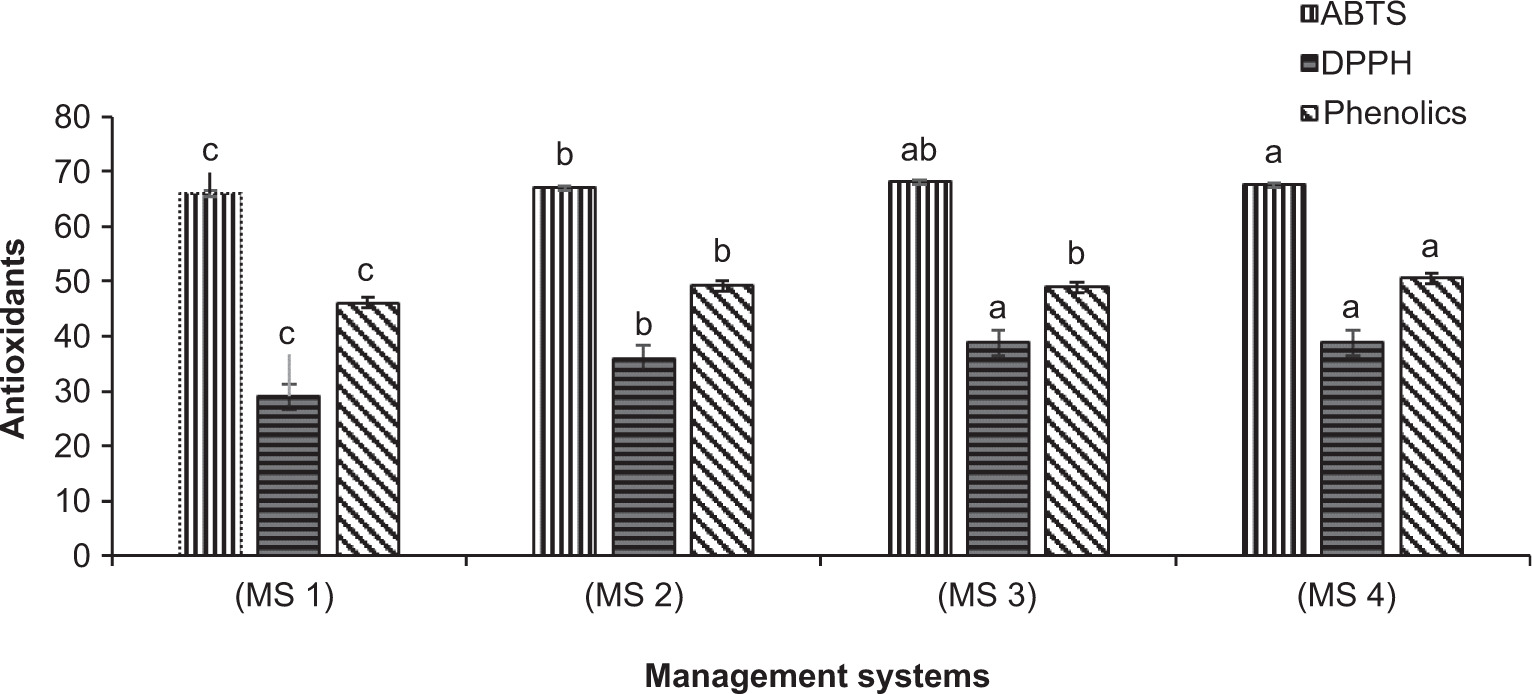
The impact of extending animal diets with SBT leaves (Hippophae rhamnoides L.) and olive tree leaves (Olea europaea L.), which involves Russian olive in broader understanding of the Elaeagnaceae family, on the bioactive summary of meat, markedly in meat goats, is an area of mounting scientific interest because of the rich phytochemical content of these plants (García et al., 2019; Saracila et al., 2022; Wang et al., 2022). The values for antioxidants and TBARS of the goat meat fed on the natural feed sources is shown in Figures 4 and 5. ABTS, DPPH, and phenolic values showed that the goat fed under MS (iv) had greater values of 67.52 μmol TE/g, 38.89 μmol MDA/g, and 50.60 mg GAE/g. While minimum values of 65.9 μmol TE/g 6, 28.97 μmol MDA/g, and 46.08 mg GAE/g were observed in the animals fed on control feed (alfalfa and grass hay).
Figure 3. Physicochemical characteristics of goat meat across diverse management systems. Mean values are shown with markers, bars represents Std± (n=3), and different letters a–b indicate significant differences between management systems, p<0.05.
Figure 4. Comparative antioxidant profiles of goat meat across different management systems. Mean values are shown with markers, bars represents Std± (n=3), and different letters a–b indicate significant differences between management systems, p<0.05.
Figure 5. TBARS Analysis of goat meat from various management systems. Mean values are shown with markers, bars represents Std± (n=3), and different letters a–b indicate significant differences between management systems, p<0.05.
Discussion
The study assessed the effects of organic feeding regimens on feed composition, growth rate, carcass trait, and meat quality considering the following proximate analysis physicochemical analysis, antioxidant properties, TBARS, and ABTS. Significant amounts of macro- and micronutrients, such as protein, lipids, vitamins, and minerals, found in SBT leaves serve as an excellent source of protein for animal feed (Hu and Guo 2006). According to Ghabru et al. (2018), SBT leaves were a valuable source of protein for animal feed because of their crude protein concentration, which ranged from 23.0% to 43.0% on a dry matter basis. The growth rate of broilers was found to be significantly impacted by the high levels of bioactive compounds and protein (20.7%), amino acids (methionine, lysine, and cysteine), minerals (Mg, Ca, and K), esterified sterols, folic acid, and isoprenols in SBT leaves (Christaki, 2012). The crude fiber content of SBT varied from 20.3% to 26.2%, depending on the region where the leaves were collected (Gradt et al., 2017). Significant differences in growth rate additionally demonstrated how dietary management strategies affect growth performance, emphasizing the advantages of MS(i) over MS(iii) in terms of optimizing weight gain results. Because of severe weather and organic farming practices, the total weight gain climbed gradually. Another explanation for the lower weight gain could be because of the higher antioxidant content and weight gain process by destroying fat molecules. Goats raised in Baluchistan ranges showed comparable weight gain (Munir et al., 2007). Researchers discovered that the wintertime decrease in the forage’s nutritional value and dormant plants were the causes of the delayed weight gain. Similar weather conditions prevail when the winter temperature falls down to −20°C, which might be the reason for the slow weight gain in the goats in the winter season.
Similarly, other researchers (Zhang et al., 2016) also noticed that seasonal variation and temperature had significant effects on the weight gain of the animals. They observed that Ewes kept in the shaded places in warm temperature WS (Warm Shed) had higher live weights than the animals in the traditional shades. Melaku and Betsha (2008) demonstrated that dietary supplementation with wheat bran and peanut cake significantly enhances weight gain in goats. The supplemented animals (goats) not only gained maximum body weight but also displayed higher proportions of offal and increased bone density as compared to nonsupplemented counterparts, which in few cases experienced weight loss. These findings underscore how targeted dietary strategies can enhance carcass composition and growth performance in ruminants. Johnson et al. (2010) reported that grain supplementation produces an additional 4 kg over the predicted end weight of 36 kg, demonstrating the benefits of energy-dense supplementation interventions. In contrast, different feeding groups in our study showing lower carcass weight may reflect the influence of bioactive plant compounds presents in both SBT and ROL which may alter nutrients partitioning and tissue deposition In support, Yusuf et al. (2014) observed that inclusion of Androghraphis paniculata significantly (p<0.05) improved weight gain, feed efficiency, live weight, and feed intake of the goats. Analogously, Oman et al. (1999) observed that feedlot-finished goats attained higher carcass weight, increased lean meat yield and lower bone proportions, and enhanced fat content compared to the animals raised on natural pasture. Together, these outcomes suggest the role of optimized feeding strategies in producing high-quality meat carcasses, ultimately meeting market demands and supporting sustainable livestock systems. These outcomes highlight the significant role of intensive feeding systems in improving meat quality and overall carcass composition in goats, compared to less controlled nutritional intake linked to grazing on natural pastures. Another comparable study was performed by Ayeb et al. (2016) to check the chemical and tissue composition of goats in different feeding systems in the arid land. The estimation showed higher fat content in animals fed on grass hay compared to the dried olive leaves and stipa tanacissima leaves. The effects of different feed on pH, protein, and mineral contents of the different meat cuts remained nonsignificant. In addition, Ijaz et al. (2020) demonstrated that the color of DFD (dark, firm, and dry) is influenced not only by pH but also by factors such as water-holding capacity, shear force, and glycolytic potential. In another study, Alexandre et al. (2009) noted less sores for meat color, less amount of lipid contents in the shoulder, less pH of the carcass in animals reared in free grazing system as compared to the meat obtained through the indoor system. The quality of forage influences the quality of the meat and carcass. Moreover, The TBARS values were significantly below 0.9 mg MA/k, which is considered the critical threshold for lipid oxidation in meat products (Moawad et al., 2013). Consequently, the elevated DPPH scavenging activity observed in the meat extract from goat supplemented with ROL can be attributed to its strong hydrogen-donating capacity.
Addition of citrus waste in meat increases the antioxidant activity of meat, as reported by (Faiz et al., 2017). Moreover, Qwele et al. (2013) showed in their result that the DPPH, ABTS, and phenolic content were increased as goats were fed on high antioxidant containing feed, namely, moringa oleifera leaves. Serpen et al. (2012) show the result as the DPPH and ABTS in meat were increased with an increase in the supplementation of organic fodder. Das et al. (2012) reported the lowest TBARS number (0.53 mg malonaldehyde/kg sample) in samples treated with moringa oleifera leaves extract and also found delayed lipid peroxidation in patties prepared from goat meat. (Hussain et al. (2020) reported that the inclusion of Chinese cinnamon powder significantly (p<0.05) reduced both TBARS and TVC in all treated samples. This suggests that Chinese cinnamon possess strong antimicrobial and anti-oxidative properties, which may contribute to the preservation of meat quality by mitigating lipid oxidation and microbial growth. Ergezer et al. (2018) further investigated TBARS levels in raw beef patties and found values higher than those observed in this current study.
Conclusion
The current study highlights the diverse flora that is conducive to supporting goat farming using organic feeding strategies. All the fodder samples used as feed for the experimental goats had a higher nutritional profile, which was reflected in the meat quality. The composition of fodder was analyzed, and the weight gain was also observed. After 6 months, the goats were slaughtered and the properties of meat were analyzed. The meat samples of the carcass of goats under four different management systems showed better results for physicochemical, antioxidants, and mineral composition. Higher growth rate was observed in Management system 1 MS (i). The other management systems MS (ii), MS (iii), and MS (iv) had low growth rates with high content of antioxidants. The higher content of antioxidants and lower weight gain is because of higher phytochemical content in feed of MS (ii), MS (iii), and MS (iv). Another reason behind the low weight gain is the harsh climatic conditions and heavy snowfall. While all grazing and feeding systems positively influenced the nutritional quality of goat meat, their impacts vary concerning specific outcomes. For antioxidant enrichment, MS (iv) appears to be the most effective system. In contrast, for optional weight gain, MS (i) demonstrates superior performance, though its effectiveness depends on resource availability and management conditions.
Acknowledgements
The authors listed in this work express gratitude for the financial support by Higher Education Commission of Pakistan (HEC) under the grant No. NRPU8212. The authors extend their appreciation to Taif University, Saudi Arabia, for supporting this work through project number TU-DSPP-2024-79.
Data availability
The data of this study are available within the manuscript.
Ethical Approval
Research ethics from Karakoram International University Compliance Committee at Gilgit gave the ethics number (EC/2018’213/25) approval for the animal study.
Authors Contributions
All authors made equal contributions to the final work’s analysis, review, and presentation.
Conflict of Interest
This study has no conflict of interest with other authors.
Funding
This research was funded by Taif University, Saudi Arabia, Project No. TU-DSPP-2024-79.
REFERENCES
Ahmad, N., Hussain, A., Khan, S., Korma, S.A., Hussain, G., Aadil, R.M., Siddique, R., Ali, A., Shabbir, U., Haq, A.U. 2021. Impact of thermal extrusion and microwave vacuum drying on fatty acids profile during fish powder preparation. Food Sci. Nutr. 9(5): 2743–2753. 10.1002/fsn3.2236
Alexandre, G., Limea, L., Fanchonne, A., Coppry, O., Mandonnet, N., Boval, M. 2009. Effect of forage feeding on goat meat production: Carcass characteristics and composition of Creole kids reared either at pasture or indoors in the humid tropics. AJAS. 22(8): 1140–1150. 10.5713/ajas.2009.80593
Alqahtani, N.K., Darwish, A.A., El-Menawy, R.K., Alnemr, T.M., Aly, E. 2021. Textural and organoleptic attributes and antioxidant activity of goat milk yoghurt with added oat flour. Int. J. Food Prop. 24(1): 433–445. 10.1080/10942912.2021.1900237
AOAC, 2006. Official Methods of Analysis. 18th Edition, Association of Official Analytical Chemists, Gaithersburgs, MD.
Ayeb, N., Ghrab, A., Barmat, A., Khorchani, T. 2016. Chemical and tissue composition of meat from carcass cuts of localgoats affected by different feeding in Tunisian arid lands. Turk. J. Vet. Anim. Sci. 40(1): 95–101. 10.3906/vet-1412-76
Bohrer, B.M. (2017). Nutrient density and nutritional value of meat products and non-meat foods high in protein. TIFS. 65: 103–112. 10.1016/j.tifs.2017.04.016
Carocho, M., Morales, P., Ferreira, I.C.F.R. 2018. Antioxidants: Reviewing chemistry, food applications, legislation and role as preservatives. TIFS. 71: 107–120. 10.1016/j.tifs.2017.11.008
Christaki, E. (2012). Hippophae rhamnoides L. (Sea Buckthorn): A potential source of nutraceuticals. Food Public Health. 2(3): 69–72. 10.5923/j.fph.20120203.02
Cuchillo-Hilario, M., Fournier-Ramírez, M.I., Díaz Martínez, M., Montaño Benavides, S., Calvo-Carrillo, M.C., Carrillo Domínguez, S., Carranco-Jáuregui, M.E., Hernández-Rodríguez, E., Mora-Pérez, P., Cruz-Martínez, Y.R. 2024. Animal food products to support human nutrition and to boost human health: The potential of feedstuffs resources and their metabolites as health-promoters. Metabolites. 14(9): 496. 10.3390/metabo14090496
Das, A., Biswas, S., Nanda, P., Chatterjee, N., Pal, S., Dhar, P., Verma, A.K., Bhattacharya, D., Koshy, R., Das, A.K. 2024. Moringa pod derived antioxidant dietary fibre as a quality enhancer in goat meat nuggets. SFT. 2(1): 232–242. 10.1039/D3FB00177F
Das, A.K., Rajkumar, V., Verma, A.K., Swarup, D. 2012. Moringa oleiferia leaves extract: A natural antioxidant for retarding lipid peroxidation in cooked goat meat patties. IJFST. 47(3): 585–591. 10.1111/j.1365-2621.2011.02881.x
El Otmani, S., Chebli, Y., Hornick, J.L., Cabaraux, J.F., Chentouf, M. 2021. Growth performance, carcass characteristics and meat quality of male goat kids supplemented by alternative feed resources: Olive cake and cactus cladodes. AFST. 272: 114746. 10.1016/j.anifeedsci.2020.114746
Ergezer, H., Kaya, H., Simsek, Ö.J.C.J. o. F.S. 2018. Antioxidant and antimicrobial potential of artichoke (Cynara scolymus L.) extract in beef patties. 36(2): 154–162. 10.17221/179/2017-CJFS
Esazadeh, K., Ezzati Nazhad Dolatabadi, J., Andishmand, H., Mohammadzadeh‐Aghdash, H., Mahmoudpour, M., Naemi Kermanshahi, M., Roosta, Y. 2024. Cytotoxic and genotoxic effects of tert‐butylhydroquinone, butylated hydroxyanisole and propyl gallate as synthetic food antioxidants. FSNT. 12(10): 7004–7016. 10.1002/fsn3.4373
Faiz, F., Khan, M.I., Butt, M.S., Nawaz, H.J.P.J. o. A.S. 2017. Enhancement of broiler meat oxidative stability through dietary supplementation of citrus processing waste. 54(4): 1–6. 10.21162/PAKJAS/17.4642
Faiz, F., Queen, F., Amir, R.M., Ahmad, A., Ahmad, Z., Ameer, K., Arshad, M., Hayat, I., Qasim, S., Kabir, K. 2020. Physicochemical, microbiological and sensory characteristics of goats reared on organic rationing in Karakoram region. LWT. 41: 381–387. 10.1590/fst.04820
Fernandez-Lopez, J., Zhi, N., Aleson-Carbonell, L., Pérez-Alvarez, J. a., Kuri, V. 2005. Antioxidant and antibacterial activities of natural extracts: Application in beef meatballs. Meat Sci. 69(3): 371–380. 10.1016/j.meatsci.2004.08.004
Ghabru, A., Chauhan, S., & Varshneya, C. 2018. Effect of Seabuckthorn leaves on Antioxidant and Microsomal Enzymes in poultry birds. J Phytopharma. 7(5): 440–445. 10.31254/phyto.2018.7507
García, E.M., López, A., Zimerman, M., Hernández, O., Arroquy, J.I., Nazareno, M.A. 2019. Enhanced oxidative stability of meat by including tannin-rich leaves of woody plants in goat diet. AJAS. 32(9): 1439–1447. 10.5713/ajas.18.0537
Gradt, I., Kuhn, S., Morsel, J., Zvaigzne, G. 2017. Chemical composition of sea buckthorn leaves, branches and bark. Proc. Natl. Acad. Sci. USA. 3: 211–216. 10.1515/prolas-2017-0035
Guo, M., Wang, Z., Gao, Z., Ma, J., Huangfu, W., Niu, J., Liu, B., Li, D., Zhu, X., Sun, H., Ma, S., Shi, Y. 2023. Alfalfa leaf meal as a new protein feedstuff improves meat quality by modulating lipid metabolism and antioxidant capacity of finishing pigs. Food Chem. (19): 100815. 10.1016/j.fochx.2023.100815
Hambaryan, M., Lai, J., Kassas, B. 2024. Informational nudges to promote preferences for goat Meat. JAAE, 56(3): 373–388. 10.1017/aae.2024.15
Hamidpour, R., Hamidpour, S., Hamidpour, M., Shahlari, M., Sohraby, M., Shahlari, N., Hamidpour, R. 2017. Russian olive (Elaeagnus angustifolia L.): From a variety of traditional medicinal applications to its novel roles as active antioxidant, anti-inflammatory, anti-mutagenic and analgesic agent. J. Tradit. Complement. 7(1): 24–29. 10.1016/j.jtcme.2015.09.00
Hu, J., & Guo, X. 2006. Evaluation of nutrient value of seabuckthorn in north China. Forestry Studies in China. 8(1): 50–52. 10.1007/s11632-006-0009-4
Hussain, Z., Li, X., Ijaz, M., Xiao, X., Hou, C., Zheng, X., Ren, C., Zhang, D. 2020. Effect of Chinese cinnamon powder on the quality and storage properties of ground lamb meat during refrigerated storage. Food Sci. Anim. Resour. 40(3): 311. 10.5851/kosfa.2019.e79
Hussain, Z., Li, X., Zhang, D., Hou, C., Ijaz, M., Bai, Y., Xiao, X., Zheng, X. 2021. Influence of adding cinnamon bark oil on meat quality of ground lamb during storage at 4°C. Meat Sci. 171: 108269. 10.1016/j.meatsci.2020.108269
Ijaz, M., Li, X., Zhang, D., Hussain, Z., Ren, C., Bai, Y., Zheng, X. J. M. S. 2020. Association between meat color of DFD beef and other quality attributes. Meat Sci. 161: 107954. 10.1016/j.meatsci.2019.107954
Innosa, D., Bennato, F., Ianni, A., Martino, C., Grotta, L., Pomilio, F., Martino, G. 2020. Influence of olive leaves feeding on chemical-nutritional quality of goat ricotta cheese. Eur. Food Res. Technol. 246(5): 923–930. 10.1007/s00217-020-03437-8
Jabalbarezi Hukerdi, Y., Fathi Nasri, M.H., Rashidi, L., Ganjkhanlou, M., Emami, A. 2020. Supplementing kids diet with olive leaves: Effect on meat quality. SRR, 193, 106258. 10.1016/j.smallrumres.2020.106258
Johnson, C., Doyle, S., Long, R. 2010. Effect of feeding system on meat goat growth performance and carcass traits. SGRJ. 25: 78–82.
Jin, Z., Liu, Q., Kong, B. H., Li, J., Chen, Q. 2013. Antioxidant activity of Seabuckthorn (Hippophae rhamnoides) leaves extracts on pork patties during refrigerated storage. Adv. Mater. Res. 781–784: 1500–1507. 10.4028/www.scientific.net/amr.781-784.1500
Kumar, Y., Yadav, D.N., Ahmad, T., Narsaiah, K. 2015. Recent trends in the use of natural antioxidants for meat and meat products. CRFSFS. 14(6): 796–812. 10.1111/1541-4337.12156
Lu, C.D., Gangyi, X., Kawas, J.R. 2010. Organic goat production, processing and marketing: Opportunities, challenges and outlook. SRR. 89(2–3): 102–109. 10.1016/j.smallrumres.2009.12.032
Melaku, S., & Betsha, S. 2008. Bodyweight and carcass characteristics of Somali goats fed hay supplemented with graded levels of peanut cake and wheat bran mixture. Trop. Anim. Health Prod. 40(7): 553–560. 10.1007/s11250-008-9133-6
Merculieff, Z., Ramnath, S., Sankoli, S.M., Venkataramegowda, S., Murthy, G.S., Ceballos, R.M. 2014. Phytochemical, antioxidant and antibacterial potential of Elaeagnus kologa (Schlecht.) leaf. Asian Pac. J. Trop. Med. 7: S599–S602. 10.1016/S1995-7645(14)60295-9
Michalea-Dimoulea, N.A., Karageorgou, A., Goliomytis, M., Tzoutzou, M., Ilias-Dimopoulos, V., Simitzis, P. 2024. The effects of a natural citrus phenolic extract on the quality attributes and oxidative stability of pariza-type meat emulsion product. Appl. Sci. 14(14): 6030. 10.3390/app14146030
Moawad, R., Mohamed, G., Ashour, El-Hamzy, E.M. 2013. Chemical composition, quality characteristics and nutritive value of goat kids meat from Egyptian Baladi breed. J. Appl. Sci. Res. 9(8): 5048–5059.
Munir, M., Jasra, A., Mirza, M. 2007. Effects of feeding and management systems on body weight and reproductive performance of Balochi ewes. Pak. Vet. J. 27(3): 126.
Muñoz-Acevedo, A., Guzmán, C.P., Peralta, N.M., González, M.C., Cervanles-Díaz, M. 2023. Taking advantage of the therapeutic/nutritional properties of some medicinal plants for use in animal feed. In Ethnobotany (pp. 1–43). CRC Press 10.1201/9781003323969-1
Muzaffar, H., Faisal, M.N., Anwar, H., Hussain, A., Khan, J.A., Muhammad, F., Aslam, B., Mahmood, A., Abdelsadik, A. & Aslam, J. 2021. Fish protein intake is a novel dietary approach for managing diabetes‐associated complications in diabetic Wistar rat model. Food Sci. Nutr. 9(2): 1017–1024. 10.1002/fsn3.2069
Nemati, Z., Amirdahri, S., Asgari, A., Taghizadeh, A., Siddiqui, S. A., Besharati, M., Alirezalu, K., Holman, B. W. 2024. Feeding pomegranate pulp to Ghezel lambs for enhanced productivity and meat quality. VAS. 24: 100356. 10.1016/j.vas.2024.100356
Nieto, G., Díaz, P., Bañón, S., Garrido, M.D. 2010. Dietary administration of ewe diets with a distillate from rosemary leaves (Rosmarinus officinalis L.): Influence on lamb meat quality. Meat Sci. 84(1): 23–29. 10.1016/j.meatsci.2009.08.001
Obeidat, B.S., & Thomas, M.G. (2023). Assessing the influence of feeding olive leaves on the productivity and economic viability of growing Awassi lambs. Cogent Food Agric. 9(2): 1–10. 10.1080/23311932.2023.
Oman, J., Waldron, D., Griffin, D.B., Savell, J.J.J. o. a. s. 1999. Effect of breed-type and feeding regimen on goat carcass traits. 77(12): 3215–3218. 10.2527/1999.77123215x
Paiva-Martins, F., Barbosa, S., Pinheiro, V., Mourão, J.L., Outor-Monteiro, D. 2009. The effect of olive leaves supplementation on the feed digestibility, growth performances of pigs and quality of pork meat. Meat Sci. 82(4): 438–443. 10.1016/j.meatsci.2009.02.014
Ponnampalam, E.N., Kearns, M., Kiani, A., Santhiravel, S., Vahmani, P., Prache, S., Monahan, F.J., Mapiye, C. 2024. Enrichment of ruminant meats with health enhancing fatty acids and antioxidants: Feed-based effects on nutritional value and human health aspects–invited review. Anim. Sci. 5: 1329346. 10.3389/fanim.2024.1329346
Qin, X., Zhang, T., Cao, Y., Deng, B., Zhang, J., Zhao, J. 2020. Effects of dietary sea buckthorn pomace supplementation on skeletal muscle mass and meat quality in lambs. Meat Sci. 166: 108141. 10.1016/j.meatsci.2020.108141
Qwele, K., Hugo, A., Oyedemi, S., Moyo, B., Masika, P., Muchenje, V. 2013. Chemical composition, fatty acid content and antioxidant potential of meat from goats supplemented with Moringa (Moringa oleifera) leaves, sunflower cake and grass hay. Meat Sci. 93(3): 455–462. 10.1016/j.meatsci.2012.11.009
Saracila, M., Untea, A.E., Panaite, T.D., Varzaru, I., Oancea, A.-G., Turcu, R.P., Vlaicu, P.A. 2022. Effects of supplementing sea buckthorn leaves (Hippophae rhamnoides L.) and chromium (III) in broiler diet on the nutritional quality and lipid oxidative stability of meat. Antioxidants. 11(11): 2220. 10.3390/antiox11112220
Serpen, A., Gökmen, V., Fogliano, V. 2012. Total antioxidant capacities of raw and cooked meats. Meat Sci. 90(1): 60–65. 10.1016/j.meatsci.2011.05.027
Vlaicu, P.A., Untea, A.E., Oancea, A.G. 2024. Sustainable poultry feeding strategies for achieving zero hunger and enhancing food quality. Agriculture. 14(10): 1811.
Vlaicu, P.A., & Untea, A.E. J.A. 2024. Feeding strategies and quality assessments of animal-derived products, MDPI. 14: 1949. 10.3390/agriculture14101811
Wang, Z., Zhao, F., Wei, P., Chai, X., Hou, G., Meng, Q. 2022. Phytochemistry, health benefits, and food applications of sea buckthorn (Hippophae rhamnoides L.): A comprehensive review. Front. Nutr. 9: 1–20. 10.3389/fnut.2022.1036295
Wang, J., Deng, L., Chen, M., Che, Y., Li, L., Zhu, L., Chen, G., Feng, T. 2024. Phytogenic feed additives as natural antibiotic alternatives in animal health and production: A review of the literature of the last decade. Anim. Nutr. 17: 244–264. 10.1016/j.aninu.2024.01.012
Wani, T. Wani, A. S., Ahmad, M., Ahmad, M., Gani, A., Masoodi, F. 2016. Bioactive profile, health benefits and safety evaluation of sea buckthorn (Hippophae rhamnoides L.): A review. Cogent Food Agric. 2(1): 1128519. 10.1080/23311932.2015.1128519
Yusuf, A.L., Goh, Y.M., Samsudin, A.A., Alimon, A.R., Sazili, A.Q. 2014. Growth performance, carcass characteristics and meat yield of Boer goats fed diets containing leaves or whole parts of Andrographis paniculata. 27(4): 503. 10.5713/ajas.2013.13533
Zhang, X., Kemp, D., Hou, X., Langford, C., Wang, K., Yan, W. 2016. Effects of shed modifications on ewe reproductive performance and lamb growth rate in Inner Mongolia. Rangel. J. 38(5): 479–487. 10.1071/RJ15127